
LHCf
L’expérience LHCf utilise les particules émises à petits angles lors des collisions produites dans le LHC pour simuler des rayons cosmiques
The Large Hadron Collider forward (LHCf) experiment uses small-angle particles created during collisions at the Large Hadron Collider (LHC) to simulate cosmic rays under laboratory conditions. Cosmic rays are charged particles from interstellar space that constantly bombard Earth’s atmosphere. Upon reaching the upper atmosphere, they collide with atomic nuclei, producing a cascade of particles on the ground. Studying how collisions at the LHC produce similar cascades could help physicists calibrate detectors in gigantic cosmic ray experiments (some of which can cover thousands of kilometers) and interpret their results.
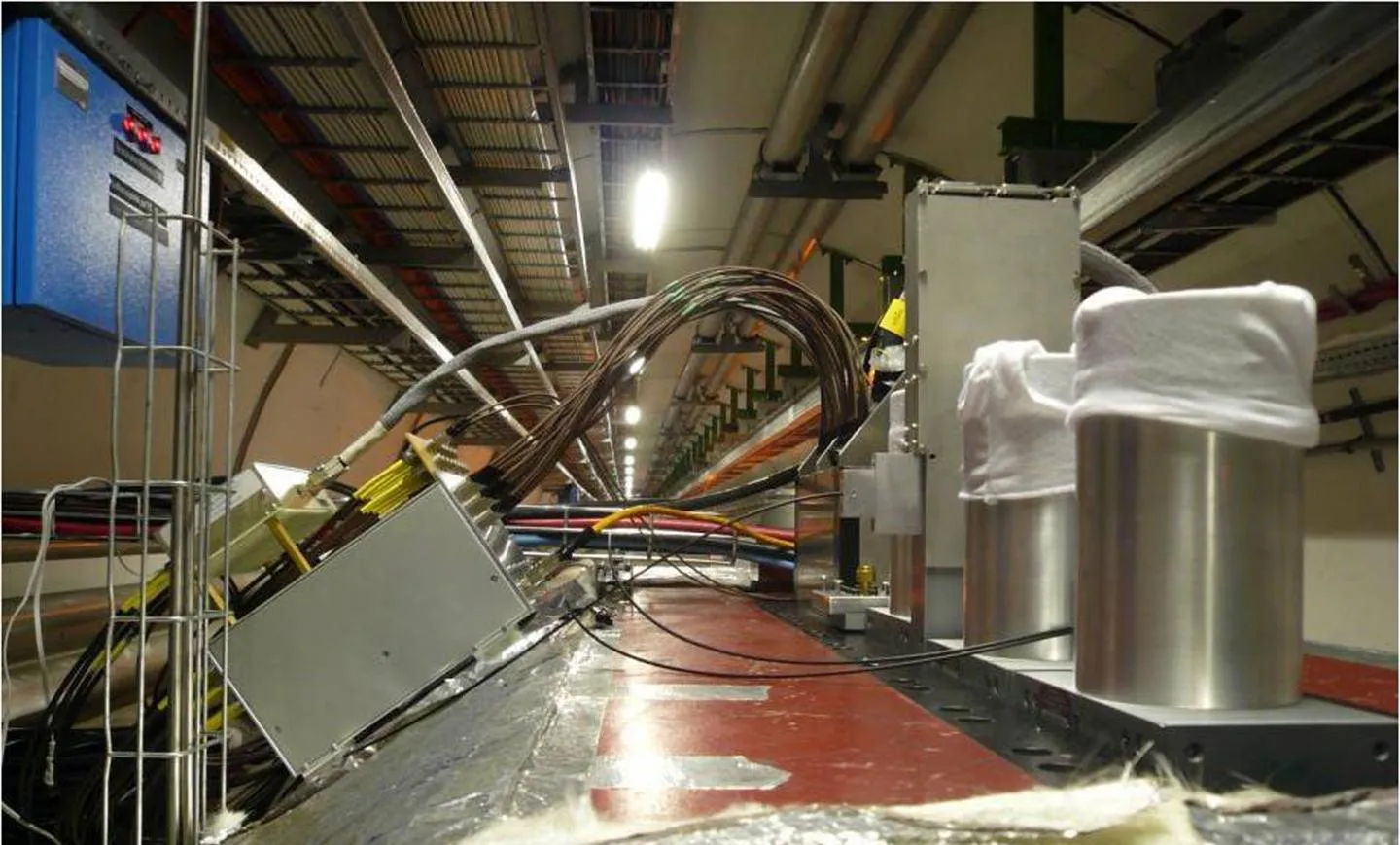
The LHCf experiment consists of two detectors positioned along the LHC beamline, 140 meters on either side of the ATLAS collision point. This positioning allows the particles to be observed at an angle close to zero relative to the proton beam. Each of the two detectors weighs only 40 kg and measures 30 cm long, 80 cm high, and 10 cm wide.